The English Literature has had an enormous impact in Western civilization, even thought their privileged position through history as one of the strongest european powers has allowed them to impose their perspective over the rest of the world. It is my intention to expose an approach to every single literary English period, trying to understand its movements and currents, comprehending why they were produced and to what historical context they were responding. In fact, I am disposed, and I have firmly decided, to divide this text in canonical periods, which are going to be: English Literature in the Middle Ages, The English Renaissance, The Restoration Age and 18th Century, The Romanticism, The Victorian age, The XXth Century and The XXIth Century. Consequently, The information exposed here has been obtained from different books and sources, such as The Norton Anthology of English Literature, directly obtained class notes from different classes at the University of Valencia and my own background and knowledge about the matter. Moreover, I will mention some historical and philosophical events during this essay, related to every single period.
English Literature in the Middle Ages: The poem Beowulf is widely known for being the starting point of English literature. Even when it relates the successful and heroic development of the hero Beowulf, and his tragic decadence we should take into account how much ironic it is. The English Literature starts with the adventures of a Danish hero, which indicate us the the influence of barbaric tribes, such as Anglos, Jutes or Saxons, who sieged and attacked Britain after the downfall of the Western Roman Empire (476 a.C).
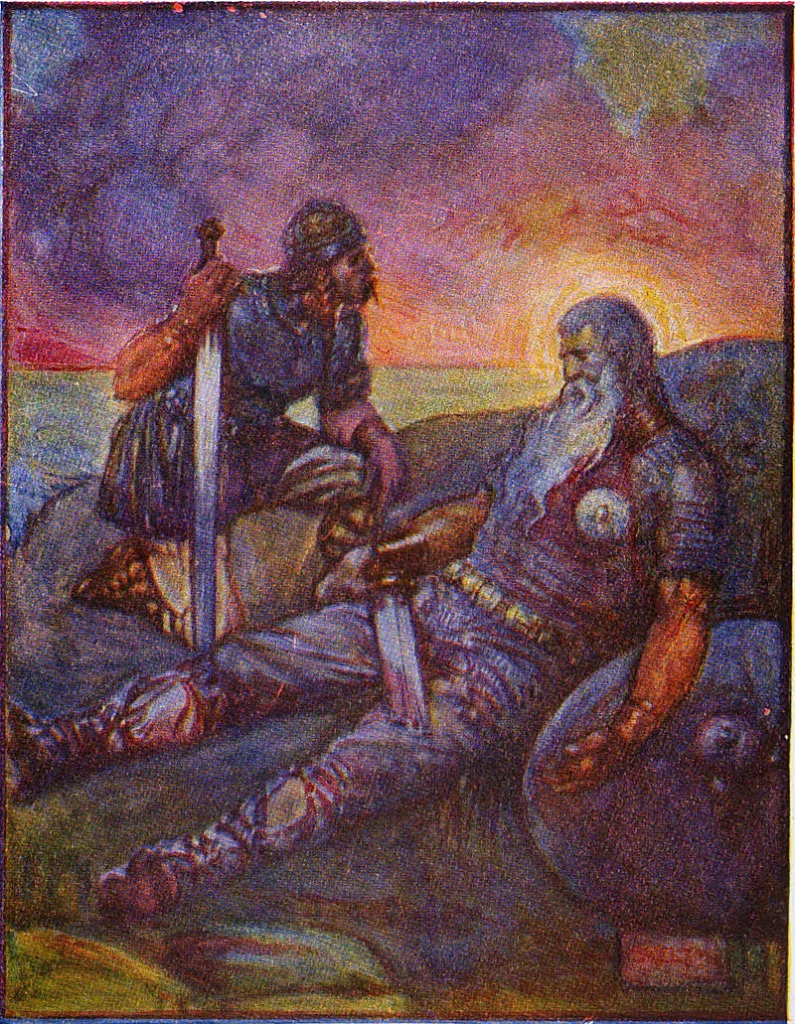
The last words of Beowulf.
We should not forget English literature during this period is often divided in two stages by historians, each one associated with a different form of English. The Old English period (450 b.C – 1066 a.C) or Old English language was the result of the mixing of many different languages. After the Romans left the country, the Latin language was mixed with the Celtic dialects (which came from the native inhabitants, these were the Britons) and the subsequent arrival of the already mentioned Germanic tribes added the high old germanic root to the British language. The next stage of development of the language was the Middle English period (1066 a.C – 1500 a. C) were the widely known battle of Hastings and the Norman invasion took place. After this, the old French language and their Romance dialects diminished the Germanic influence over the English language. As a result, the Romance influence gave birth to the matter of Britain, which was the compendium of legends of Arthur and the knights of the round table. The book Historia Regum Britanniae written by Geoffrey of Monmouth is the central pillar of the matter of Britain, even when it has been nurtured by many different sources, until Thomas Malory wrote his compendium in 1485: Le Morte d’Arthur.
We should not forget to mention another really important works of the era, such as Sir Gawain and the green knight (part of the Matter of Britain) or the poem Piers Plowman by William Langland. However, the most important work of this period is without question “The Canterbury Tales”, written by Geoffry Chaucer. It is inspired by the italian work The Decameron, written by Boccacio (Italian poets such as Petrarch, Boccacio or Dante had an enormous influence in Europe during the Middle Age) , and it is considered one of the masterpieces of the English Literature.
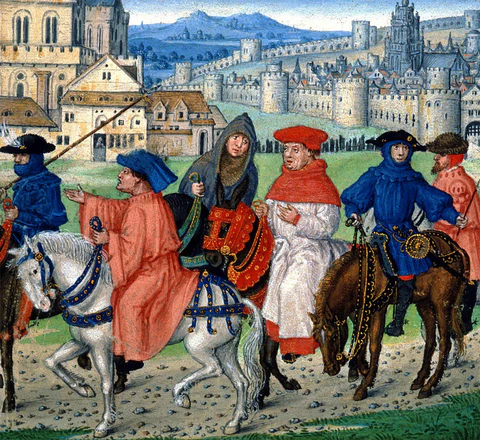
The Canterbury tales, pilgrims’ picture.
Before we continue with the next period I would like to add some important historical and philosophical facts and dates. We should keep in mind that during this period knowledge was explicitly reserved to the servants of Christianity. As a matter of fact, they had a lot of influence of Greek and Roman philosophers, such as Plato or Aristotle. However, they had a different perspective about truth or other aspects of life, using their teachings and linking them with their own truth:Christianity and god. The most important philosopher of this period was Saint Agustine of Hippo.
Historically, during the Middle Ages many events happened across Europe, so I have chosen some events I consider very worthy to know:
- Western Roman empire’s downfall – 476 a.C
- The birth and expansion of Islam – 622 a.C
- Charlemagne’s reign – 800 a.C
- The hundred years war – 1337 – 1453
- Constantinople’s downfall – 1453
- America’s discovery – 1492
 Jorge Rodríguez Monzón.
Deja un comentario