Historical info
Poetry in old english / medieval period
Religious and epic poetry dominated the period, along with proverbs, riddles and charms, and are characterised by alliteration rather than rhyme. (Beowulf).
After the norman invasion and the french influence in the english language, becoming the Middle english, the poetry devellops rhyme and rhythm as the distinguishing characteristic, replacing alliteration ( The Canterbury tales).
The Renaissance (XVI , XVII centuries)
Authors like Shakespeare, Spencer and John Milton dominated the period, develloping poetry and making it more complex, adding figurative language such as metaphors, personifications, similes or hyperboles.
The XVIII century
Satire and wit influenced completelly this period. Authors like Alexander pope and Jonathan Switft were very important. The translation of the clasical greek and roman authors was crucial in this period
The Romantic era XVIII and XIX centuries
Poetry before the Romantic period was considered something really complex. It was more related to hard work than inspiration. Many poets even knew latin or ancient greek. The romantic poets began to move away from the strictest poetic rules of metre and rhyme. In fact, some typical themes were nature or the idealiced love. Some of the great names of this period are William Blake, William Wordsworth, Coleridge, Percy Shelley, Lord Byron or Keats.
The Victorian poetry
Victorian poets had a lot of influenced of romantic poets. Moreover, they also were very influenced by tecnology and science.
Types of figurative language
Metaphor
A metaphor is an implied comparison, in contrast to the explicit comparison of the simile
Heart of stone, time is money, Life is a journey
Simile
An explicit comparison of two things using words such a: like, than or as.
As cold as ice, fight like a cow
Personification
The attribution of personal features to objects or ideas.
Love is blind, the lights winked,
Hyperbole
An exageration
I could sleep forever, I had tons of homework
Oxymoron
Opposite concepts in the same line
Minor crisis, Bittersweet
Antithesis
Opposite concepts in different sentences
Hope for the best, prepare for the worst.
Paradox
Play of words that initially doesn’t seem to make sense, but it makes.
The begginning of the end, save money by spending it.
Hypophora
When the author asks a question and then answers it. It is used in essays to bring the subject on another direction or reinforce it.
What’s the benefit of completing the optional exercises? They will help you study.
Rhetorical question
a questions that needs no answer because it is confirming something
How can he be so stupid ?
Apostrophe
The speaker adresses a dead or absent person
Grandma, I know you’ll always be with me.
Apophasis
The raising of an issue by claiming not to mention it.
It’s not my habit to comment on books that don’t interest me or, for various reasons, I don’t like.
Synecdoche
When we say a word meaning a group and viceversa.
He’s got more brains (inteligence) than anyone else, We need some more hands (people).
Metonymy
It is a figure of speech in which something that is related to the subject is used instead of the actual subject itself
I swore allegiance to the Crown, a hired gun,
Alliteration
Repetition of a consonant sound in several consequitive words.
Fair is foul, foul is fair
Anaphora
Repetition of the same words, specially at the beginning of sentences
Five years, five summers
Tricolon
Groups of three words
Life, Liberty, and the Pursuit of Happiness
The Sonnet and poetic concepts
- 14 lines
- Normally 10 syllables per line.
- Iambic Pentameter (the rhythm or metter stablished by the words in each line) . Rhythm is measured in small groups of syllables called feet, The Iamb feet means an unstressed syllable + an stressed syllable.
Shakesperean sonnet rhyme scheme: ABAB CDCD EFEF GG (3 quatrains and 1 couplet)
Petrarchan sonnet rhyme scheme: ABBA ABBA CDE CDE (1 octet and 1 sestet)
The rhyme scheme can be enclosed (ABBA) or alternated (ABAB).
Masculine rhyme: When the second syllable is stressed: Confessed, Adressed
Femenine rhyme: When the first syllable is stressed: Shaken, Taken.
Hemistich: a half-line of a verse
Caesura: Pause or break ( usually for sense) between two hemistichs
Enjambment: When a verse doesn’t finish with the punctuation mark and continues in the next verse
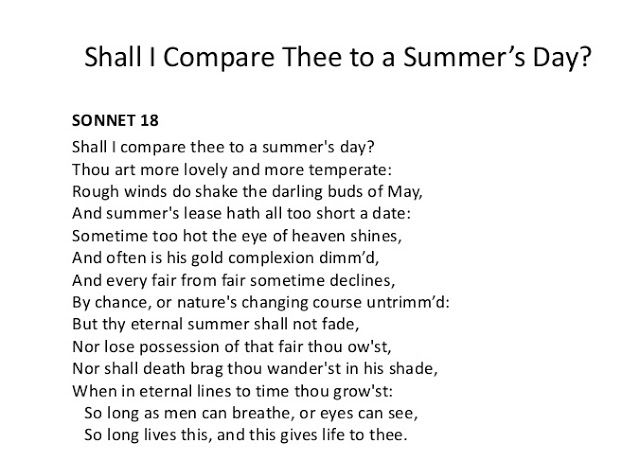
The most famous sonnet in English language, Sonnet 18 by William Shakespeare.
Poetic Metre
Iambic foot: Resembles regular human speech. Unstressed beat + Stressed beat
A-gain, ce-ment, to be, be-spoke
Trochee foot: The opposite of Iambic, Stressed beat + Unstressed beat.
Sha-dow, Eng-lish, Da-vid
Spondee foot: Stressed Beat + Stressed Beat
Big deal, Tom Jones
TRISYLLABLES
Dactyl: Stressed + Unstressed + Unstressed
Po-et-ry, E-le-phant, Ann-a-belle
Anapaest: Unstressed + Unstressed + Stressed
Un-der-stand, Rec-og-nise, Gra-vi-ty
Amphibrach: Unstressed, Stressed, Unstressed
Con-di-tion
 Jorge Rodríguez Monzón.
Deja un comentario